
The Conservation and Restoration of the Tomb of Sir Thomas Sutton
Sutton’s Hospital in Charterhouse, Charterhouse Square, London EC1M 6AN
The Death of Sir Thomas Sutton
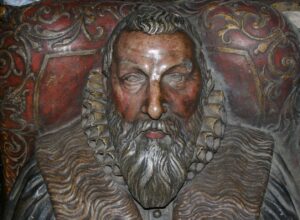 At the time of his death on the 12th December 1611, Thomas Sutton was the richest commoner in England. His fortune had been accumulated from the lease of the Durham coalfields and favourable leases of manors that he held from the bishopric of Ely. In 1582 he had married Elizabeth Dudley – the wealthy widow of John Dudley of Stoke Newington. He was also a respected moneylender: a service that had been expanded to benefit the whole spectrum of society. Sutton’s links with the crown also reinforced his prominence in society.
Sutton bequeathed his fortune to the establishment of a large 80-bed almshouse and a school at the Charterhouse in London, ‘Creating the most lavish endowed charity established between the reformation and the foundation of Guy’s Hospital in the 1720’s.’
Upon his death, two executors were named: Sir Richard Sutton (no relation) and John Law who died two years after Sutton in 1614. A legal challenge was made to the will by Sutton’s nephew, Simon Baxter who believed himself to be the legal heir by law and was opposed to his uncle’s charitable bequest. Sir Richard Bacon, a man who was sympathetic to Baxter’s challenge and who also believed that the establishment of the proposed large almshouses was not in keeping with the smaller establishments that were the current trend in the early 17th century, represented him.
There were many other high profile figures in society who frowned on the establishment of the large almshouse at Charterhouse. Thomas Gainsford and Henry Etherington were two outspoken critics of Sutton’s bequest,
“Wealth begets envy and the contents of a will produce disappointments as well as gratitude, whilst such an overt demonstration of his wealth could be construed as vanity, even though applied to benefit the disadvantaged.”
Etherington’s belief was that the giving of alms should be done compassionately and without pride and that the donor should not seek to gain merit from the gift. However, his legal challenge to Sutton’s will was not upheld largely due to the Archbishop of Canterbury and the Bishop of Ely who were charged with overseeing the will.
On the 12th December 1614, on the second anniversary of his death, Sutton’s body was moved in an elaborate, candle-lit procession from Christchurch in Newgate to its final resting place in the newly built tomb in the chapel at Charterhouse. Many believed that the tomb, designed and constructed by Nicholas Janssen, Nicholas Stone and Edmund Kinsman was pretentious and inappropriate for someone of his social standing.
The Sculptors of the Tomb
The Flemish Influence
“The emigration of Flemish artists to England in the 16th century was in its inception an artistic movement; an art-loving King was a magnet attracting artists from all over Europe.”
Artists and craftsmen flooded to Britain, but the immigration began to take on a new perspective when Henry VIII broke with Rome, Italian artists became less in demand and other religious conflicts broke out across Europe. England became a place of asylum for protetstant refugees from the Low Countries.
Many of the artists adopted the Baroque style that was born out of the Roman church’s reaction against the adoption of new forms of its religion. Many sculptors of this movement relied on direct, simple and obvious dynamism often exhibited in the human form.
“The word ‘Baroque’ was a term employed by critics of a later period who fought against the tendancies of the seventeenth century, and wanted to hold them up to ridicule.”
Baroque simply means absurd or grotesque and opposed the strict rules adopted by the Greeks and Romans.
Nicholas Stone (1586-1647)
Nicholas Stone was appointed the Master Mason to James I in 1619 and to Charles I in 1626. The Dutch sculptor Hendrick de Kyser (1565-1621) was a great influence on Stone and his style was known as ‘Mannerist’ – referred to as ‘Amsterdam Renaissance’ – a style that displayed an artificial, even absurd, sense of reality rather than the naturalistic qualities exhibited by the Renaissance artists who inspired them. He was responsible for the tomb of William the Silent (William I, Prince of Orange) that is situated in New Church in Delft. However, he did not live to see the fruition of this work that was completed by his son Peter.
Stone met his mentor whilst de Kyser was visiting London in 1606. He undertook an apprenticeship in Holland where he eventually married de Kyser’s daughter and worked alongside his son Peter and fellow pupil Bernard Johnson (Janssens).
Amongst many significant works, Stone is most famous for two influential funerary monuments in Westminster Abbey: the box tombs of Sir George Villiers and his wife the Countess of Buckingham and Lionel Cranfield, Earl of Middlesex and his wife. Two other works of note are a remarkable sculpture in St. Paul’s Cathedral of English poet John Donne and an effigy of Elizabeth, Lady Carey in Stowe Nines Church in Northamptonshire. Stone was also master mason for Inigo Jones’ Banquetting Hall in Whitehall.
Nicholas Johnson (Janssen)
Johnson was the son of Gereart Janssen who left Amsterdam in 1567 as a Protestant refugee and became an English citizen the following year. On arriving in England, Gereart settled in Southwark and changed his name to Johnson. He made his reputation as a tomb maker, but also produced chimneypieces and fountain bases. It is often stated that he had four sons who were all sculptors: Bernard, John, Nicholas and Gerard the Younger, but his will of 1612 appears to contradict this and mentions only two sons.
Bernard, who had previously worked alongside Nicholas Stone in Amsterdam, appears not to have been a son of Gereart. he went on to become head mason for Northumberland House in The Strand and at Audley End in Essex – one of the most impressive Jacobean houses. Gerard the Younger was responsible for the Shakespeare monument in Stratford upon Avon, whilst little is known of John Johnson or his work.
Edmund Kinsmen
Edmund Kinsman was a leading master mason based in London during the early 17th century. The dates of his birth and death have not been ascertained but he was Master of the Masons’ Company in 1635. Between 1613-1614 he worked at The Charterhouse under Francis Carter who had become Chief Clark of the King’s Work on the 22nd February 1614 – a position he held until his death in 1630. As a senior officer in the royal works during the surveyorship of Inigo Jones, Carter – a carpenter by trade – demonstrated ability as an architectural designer. His style exhibited a new sophistication somewhere between Elizabethan mode and the pure classicalism of Jones’ work.
Kinsman was involved in the building of the north aisle of The Charterhouse chapel. Between 1615-1616 he worked alongside Nicholas Stone on the tomb of Sir Thomas Sutton. He was also employed by Jones to work on Newmarket, Oatlands and St. Paul’s Cathedral. He was also involved, along with Mathew Banckes (senior), with the buidling of St. Alban’s Church in Wood Street and also the ‘lanthorn’ on the tower of St. Mary-le-Bow that was crowned with a stone lantern supported by four flying buttresses. He was also responsible, along with three other masons, for re-building the west tower of Godhurst Church in Kent.
Kinsman’s church commissions suggest that he too was more at home with the mixing of classical and Gothic. This style is demonstrated at one of the significant Jacobean churches, St. Katherine Cree at Aldgate, London.
The Charterhouse Chapel
 The Charterhouse site was acquired by Sir Walter de Mauny, a distinguished soldier and courtier, as a burial ground for victims of the Black Death which struck London in 1348. The original chapel that was subsequently built for the graveyard became the church of the Carthusian Priory that de Mauny founded in 1371. It was a simple rectangular construction that contained a presbytery and choir. The priory was one of the largest in medieval England and received financial backing from the Crown and aristocracy.
After the dissolution, sections of the building were destroyed but some survived and were incorporated into Sir Edward North’s magnificent Tudor mansion that was built in 1545-6. The only part of the original church that survives today is a section of the south wall of the chapel nave. these surviving sections were embellished and elaborated on in the early 1770’s by Thomas, 4th Duke of Norfolk. These were the buildings that Thomas Sutton acquired for his almshouse and school in 1611.
Surveyor Francis Carter was appointed to work ar Charterhouse before Sutton’s death. In 1614, Carter worked as Chief of Clerks alongside Inigo Jones, Surveyor of the King’s works. Carter was retained by the governors and was responsible for the conversion of the buildings and the enlargement of the Charterhouse chapel. Carter was responsible for the connection of the chapel to the courtyard house by constructing an open arcade of six Italian semi-classic arches. Charterhouse has cost Sutton £13,000 and the governors spent £8,000 adapting it for purpose.
In 1636 John Colt the Younger, supplied a stone reredos for the chapel. It portrayed the Ten Commandments on two white marble tablets. It was flanked by alabaster figures of Aaron and Moses with an elaborate surround. It was presented on a cornice with a semi-circular panel featuring Jehovah. Other changes, commissioned by William Laud, chairman of the governors and Archbishop of Canterbury, were made to the chapel in 1635 included the building of a raised sanctuary with wooden rails that housed the communion table.
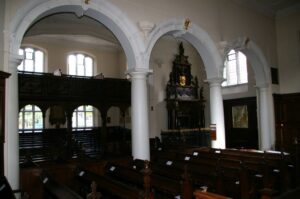
The chapel is a typical Jacobean building and Sutton’s tomb is situated in the north-west corner. The ante-chapel is vaulted and groined and the bosses that bind the ribs are decorated with roses, foliage and shields, charged with the Instruments of the Passion. The relatively modern font contrasts with the perpendicular style of the ante-chapel that bears the date 1512. The equilateral arch at the east, leading to the main chapel is considered to have been the nave arch of the original monastic church.
The present chancel is considered to be part of the original nave. It is square and divded centrally by two Tuscan pillars. An aisle was added to the north side in 1826. The pillars support three semi-circular arches, the keystones of which are decorated with the Charterhouse arms. The roof is flat, ceiled and decorated after the style of James I.
At the west end, under the tower, is a wooden carved screen decorated in a grotesque style displaying images of cherubim, helmets, swords, drums and musical instruments. A central shield displays the arms of the hospital. The structure is contemporary with the rest of the chapel and supports a gallery that houses the organ. The five east windows depict the Divine Passion in painted glass and were the gift of the Venerable Archdeacon Hale. Another east window depicts the Bearing of the Cross, whilst one of the southern windows contains fragments of glass representing the Charterhouse arms.
The pulpit and reading desk are against the south wall with canopied preacher’s pews. The pensioner’s seats are open and are embellished with the heads of greyhounds – a motif from the Sutton coat of arms.
The Tomb
Costing for the Construction of the Tomb and Funeral Expenses.
The submitted quote for the construction of the tomb and funerary expenses were a total of £366-15s-0d. The actual payments made to those reponsible for the build and interment read as thus:
30 November 1614 Payment to masons: Johnson/Kinsman/Stone £100-00s.-00d.
19 December 1614 Payment to William Shaw – Blacksmith £20-00s.-00d.
26 January 1614/15 Payment to Edmund Kinsman Richard Broughton
and Richard Hudson for construction of a vault
under Sir Thomas Sutton’s tomb in the chapel at
The Charterhouse: 10′ in length/7′ in breadth/6′
in height £9-19s.-10d.
10 February 1614/15 Payment to masons: Johnson/Kinsman/Stone £100-00s.-00d.
18 February 1614/15 Payment to William Shaw – Blacksmith £20-00s.-00d.
13 May 1615 Payment to masons: Johnson/Kinsman/Stone £60-00s.-00d.
14 June 1615 Payment to William Shaw for ‘Ironwork’ £20-00s.-00d.
7 October 1615 Payment to masons Johnson/Kinsman/Stone £40-00s.-00d.
20 October 1615 Payment to William Shaw – Blacksmith £20-00s.-00d.
23 November 1615 Full payment to WIliiam Shaw – Blacksmith for
Iron Work and Weighing: 24 1/4 cwt. 14lb.
After the wieght of 9d. a lb. amount to: £102-00s.-00d.
24 November 1615 Full payment to masons: Johnson/Kinsman/Stone £100-00s.-00d.
22 February 1615/16 Payment to Matthew Goodrick – painter for
colouring iron good of Mr. Sutton’s tomb £0-60s.-00d.
26 March 1616
Moving corpse from Christchurch to Charterhouse
Making of a bier £0-17s.-4d.
X2 Trestles to lay corpse upon in vault £0-2s.-00d.
For carrying corpse from Christchurch
to Charterhouse through Aldegate £0-25s.-4d.
For biscuit, bread, confits, figs and
raysons, wine etc. spent at Charterhouse
at the said corpse there £0-55s.-8d.
For X4 dozen torches, for fees and duties
of the church wardens, vicar, clarks and
others at Christchurch for breaking of the
ground there £0-36s.-00d.
Total £33-6s.-4d.
Total of funeral charges for the tomb £514-19s.-4d.
We can see here that the actual costs for the tomb and funeral expenses were significantly higher than the original quote of £366-15s.-0d.
Description of the Tomb
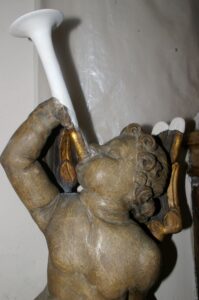
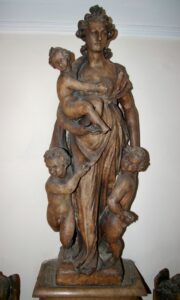
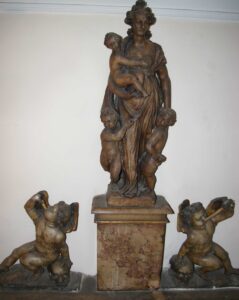
 At the very top of the monument stands a 920mm high alabaster figure of Charity, mounted on a marble plinth. She is draped in a long flowing ‘classical style’ garment, tied at the waist, with both breasts exposed. Charity is depicted holding a small male child in her right arm who stares outwards. The child’s left arm is around her neck whilst the right hand supports her left breast. Two naked male children stand either side of her at her feet. The left child holds onto her drapery, whilst the other child holds what appears to be an apple in his left hand whilst his other arm is held in Charity’s left hand. All carved alabaster figures stand upon a plinth with a brick core faced with pink ornamental marble that has an upper moulding of alabaster. Either side of the plinth are painted carved alabaster cherubs seated upon skulls. Each holds aloft a gilded horn.
Charity is one of the three theological virtues of the Christian faith: the other two being Faith and Hope (who also appear further down the monument). She is portrayed as kindness and love – that is love of God and love of man. She was often portrayed as a mother with three infants: most famously in Flemish Baroque artist Sir Anthony van Dyk’s depiction in 1627. As the founder of The Charterhouse School and for bequeathing a large part of his fortune to the establishment of a hospital on the site of his house on Charterhouse Square, it seems appropriate that Charity presides over Charterhouse’s most famous founder and benefactor.
The presence of noble and biblical figures such as, Faith, Hope, Charity, Justice, Fortitude, Patience, Humility, Temperance and Chastity were intended to improve and strengthen the character of the host. The use of these symbols during the 17th century were common amongst Flemish and German craftsmen.
Winged creatures known as Cheribum are mentioned in Ezekiel as bearing the throne and chariot of the deity and were later depicted as a type of angel. They were however, a lesser order of ancient Mesopotamian deity: a winged human-headed bull who guarded the gates of the royal palace.
Cherubs, or depictions of a winged-child’s head were very popular ornamentations in 17th century scuplture. Their presence on a tomb signifies a divinity or someone with divine wisdom.
Below the upper section a heraldic relief panel bearing the Sutton coat of arms is topped by an heraldic helmet and talbot, all is surrounded by mantling. Two black columns with gilt Corinthian capitals flank the panel and alabaster strapwork wing brackets are set against the wall. On this level there are also two large alabaster figures of Peace and Plenty. In secular allegory Peace represents the end of conflict and war and celebrates the outcome of good governance and typifies the pacific qualities of a statesman. Her presence on the tomb is likley to represent the peace at the end of the industrious life of the deceased. The figure holds a dove – an attribute deriving from Genesis (8:10:11): the dove returned to the ark, ‘towards evening with a newly plucked olive leaf in her beak.’ In Greek and Roman art, God’s messengers, Hermes or Mercury often carried a ‘caduceus’ – a wand entwined with serpents – as the insignia of the messenger who was always granted peaceful passage.
Plenty is a symbol of abundance and nourishment. She is holding the cornucopia – the horn of plenty, a sign of virtue and beneficent personifications: most apt for the generous benefactor of Charterhouse. The cornucopia of Fortune often appears on Renassisance medals as a celebration of public rejoicing. It is also considered and attribute of hospitality.
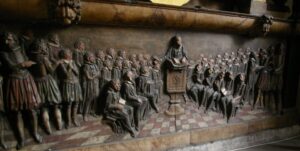
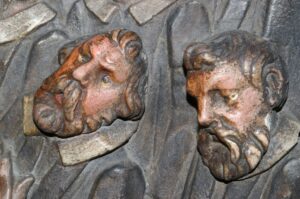
The central polychromed bas-relief panel is known as the ‘Preacher Panel’. It depicts 52 figures including a preacher. The number of figures is likely to reflect the 52 weeks of the calendar year and is in keeping with the monument’s theme of the cycles of life. The carved panel has strong Protestant imagery with the emphasis being on the pulpit and not the altar that was popluar before the Reformation. Two carved alabaster heads sited just above the panel oversee the congregation. During the Middle Ages, the lion became a symbol of the Resurrection in religious and secular art. According to the beastiaries, the lion cubs were born lay dead for three days until their father brought them back to life by breathing in their faces.
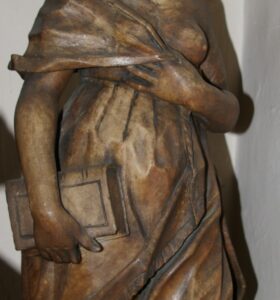
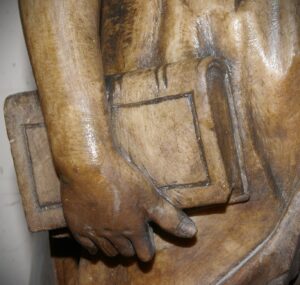
On this level are also two large alabaster female allegorical figures of Faith and Hope and two putti (a representation of a naked child, cherub or a cupid in Renassaisance art) figures. Originally, the alabaster figure of Faith (holding a Bible) was positioned on the inner front pedestal flanking the west of the tomb and Hope (holding an anchor) was on the inner front pedastal on the east flank. Along with Hope and Charity, Faith is one of the three theological virtues. In Gothic art she occupies the place of honour on the right hand of Christ. It is noteworthy that the tomb builders originally placed her in this prestigious station on Sutton’s tomb.
The anchor, which is in the possession of Hope, is a recognised symbol of hope and steadfastness. It is often associated with St Nicholas and St Clement. Its association originates from the Epistle of the Hebrews 6:19 where the words express the everlasting virtue of God’s counsel: ‘Which hope we have as an anchor of the soul both sure and steadfast…’
The two putti were positioned on the outermost pedastals with Labour (holding a spade) on the west and Rest (holding a mop) on the east flank of the tomb. The putto positioned on the west flank holding a spade is a representation of industry and dexterity. His opposite number, Rest, is brandashing a mop: a symbol of domestic chores. The juxtaposed combination of industry and domesticity suggests the balance and division of labour spent during a lifetime. The fact that the putto, with the mop, is resting his tool on a skull suggests the inevitable end to life’s ardour. Once again, the monument’s imagery suggests that a balance be struck between work, rest and play.
Cecil Thomas restored the tomb in 1951 and during this undertaking he not only switched the two female alabster figures of Faith and Hope, but placed them on the outer pedastals; bringing forward the two putti figures who were ‘promoted’ to the inner front pedastals, although they remain on their original flank of the monument.
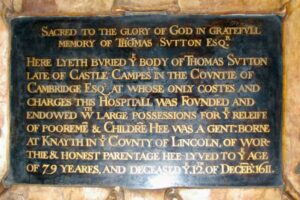
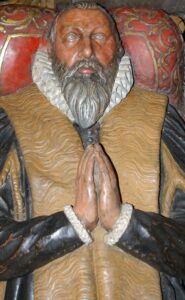
Below this level is a polychromed effigy of Thomas Sutton with his hands clasped in prayer. He lies in an architectural recess with a coffered ceiling. Ornate alabaster relief panels and four black columns with gilt Corinthian capitals flank this space. Above the recumbent figure of Sir Thomas Sutton and just below the coffered ceiling are three angels of Death; guardians of the deceased and two gilded horned figures who act as warning of the lurking presence of evil. On the back wallof the recess is a black painted panel that has been signwritten:
“Sacred to the glory of God, in grateful memopry of Thomas Sutton, Esquire. Here lieth buried
the body of Thomas Sutton, late of Castle-Camps, in the county of Cambridge, Esquire, at
whose only costs and charges this hospital was founded and endowed with large
possessions for the relief of poor men and children. He was a gentleman, born at knaith, in
the county of Lincoln, of worthie and honest parentage. he lived to the age of seventy-nine
years, and decesaed the 12th of December, 1611.”
On top of this signwritten panel are two naked polychromed and gilded figures: a winged infabt blowing gold bubbles and Old Father Time. The child is most likely a representation of Veritas – the Roman merit of truthfulness – one of the main virtues any Roman should possess. the fair skinned child blows bubbles that provide us with a reminder of the fragility of life and also the playfulness of youth.
Disparate to the winged infant is Old Father Time: also winged and naked with his long beard cobering his modesty, he holds a scythe and reminds us of our fate. His skin appears leathery and aged compared to the child by his side: evidence of a life od industry and toil. Between the two figures is an hourglass on a skull. The sands of time occpuy the bottom portion of the vessel, demonstrating that Sit Thomas Sutton’s time has now passed.
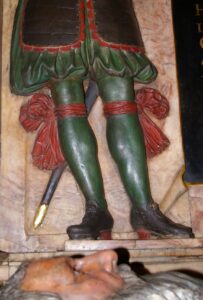
Two Jacobean soldiers in full military dress flank the inscription panel. Their presence is there to demonstrate Sir Thomas Sutton’s position as Master of Ordnance in the North Parts of England between 1569 and 1594.
The polychromed carved alabaster inner-side walls of the recess are also decorated depicting grapes on a vine alongside pomegranates. The vine is synonmyous with Christ, who in John Ch. 15:1, declared himself the ‘true vine’: “All other vines are fraudulent. He alone is the true source of everlasting, abundant life.” (John 14:6.). In many Middle Eastern and Mediterranean cultures the pomegranate was a symbol of fruitfulness and fertility. Sandro Botticelli’s ‘Madonna of the Pomegranate’ (1487, Uffizi Gallery, Florence) depicts the infant Jesus, in the arms of Madonna, holding as pomegranate. The use of fruit alongside the vine on Sutton’s tomb provides subtle Roman imagery and further evidence of Renassaince influence on the monument.
The west outer side of the recess is decorated having carved and polychromed images with military associations: a quiver of crossed arrows, a knight’s helmet and a shield with crossed pikes. The east side is carved with a green man, a cannon and a helmeted profile, these carvings have no polychromy. This side is positioned very close to the wall making it diffuclt to view. The lack of painted decoration is strong evidence that the tomb was polychromed and gilt after it had been erected on site. The attention to detail on the east side relief that was never going to be viewed leads us to question whether the site of the tomb was changed after the monument had been manufactured.
It is understood that the tomb had receievd two previous restorations, the first in the 18th century and the most recent in the 19th century.
The Condition of the Tomb
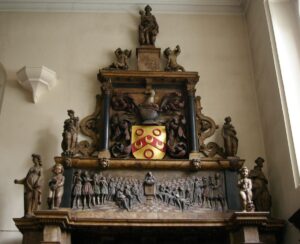 Although structurally sound the tomb was in an extremely dirty condition. There were many missing parts, mostly small and found on the extremities. There were numerous previous fills and evidence of over-paint and retouching. The tomb has received a restoration during the 18th and 19th centuries. The 19th century restoration saw the tomb partially repainted and gilded and at this time the surrounding railings painted black.
The Charterhouse had significant bomb damage during WWII and Seely and Paget carried out a restoration of the site in the early 1950’s. At this time the alabaster figures on the first platform (which were removed from the tomb at the start of the war) were replaced, albeit two (Faith and Hope) were repositioned incorrectly. No cleaning or repair was carried out at this time except for the re-gilding and painting of Sutton’s shield (see left).
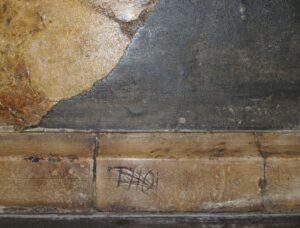
On the ledge under Sutton’s shield are two sets of initials scratched into the alabaster, these are likely to be the initials of the 19th century restorers.
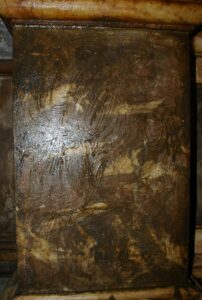
 Numerous weft and warp impressions were evident on the exposed soft alabaster, these were created by the material sacking of the sand bags that had covered the tomb during WWII. The weight along with the moisture retained in the sand bags impressed on the soft alabaster.
Original accounts show the materials used to create the tomb. They state that Rance marble (a red Belgium marble) had been purchased and used, however, this marble is not evident on the tomb. After thorough inspection the Rance marble was identified as the construction material of all columns. At some stage the columns had been over-painted in black (see right). It is not known when this paint had been applied. It may be possible that the columns had been painted at the time of the construction of the tomb.
An early painting (see below) shows an interpretation of the tomb before its present scheme, therefore possibly; the original scheme. The soldiers had a light metallic finish to their armour and the lettering in the central plaque just above the effigy is depicted as white. It is fair to assume that this is a correct interpretation at the time of painting, but why paint over Rance marble? Had the columns been painted black at the time of contruction or added later to be more in keeping with the later 19th century colour scheme?

The associated railings had also been over-painted in black. The railings are reputed to have been taken from a site elsewhere in London.
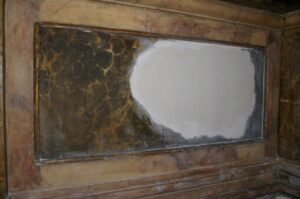
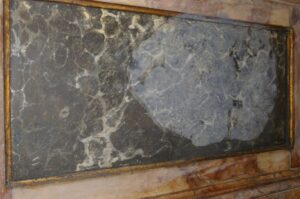
The painted faux marble panels below the effigy had two large areas of loss (see left), revealing a slate substrate. This painted finish was applied onto a plaster skim.
The Restoration – An Overview
The objective was to clean all surface areas and to consolidate as and where necessary. To remodel selected missing parts, retouch and re-gild where necessary to achieve a pleasing aesthetic whilst maintaining the integrity of the tomb’s history. The objective was not to remove any satisfactory previous work and/or overpaint.


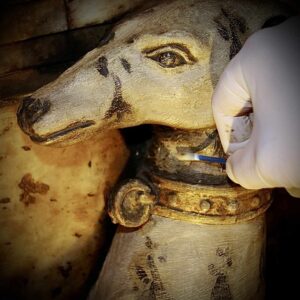
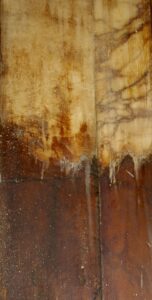
All surfaces required different cleaning considerations due to the differing nature of the materials present. In many areas the cleaning revealed the beauty of the marble and alabaster that had been hidden under layers of dirt for many years.
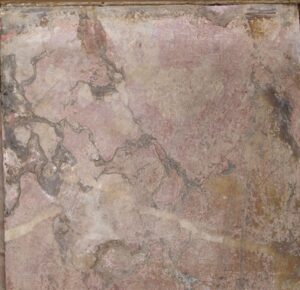
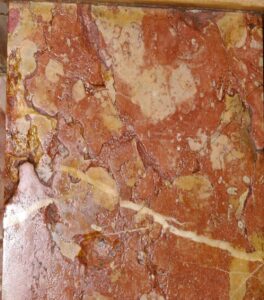
An example of the effectiveness of the cleaning can be seen on the pink marble frieze just below the canopy. It was pitted and dirty, the cleaning had revealed the colour and detail (see below).

The Heraldry
The shield had previously been gilded and painted during the Seely and Paget restoration in the early 1950’s. The remaining surfaces in this area were cleaned. Detached parts of the mantling were re-attached and missing elements remodelled and replaced. All this was followed by retouching and re-gilding where appropriate. There had been a history of the redecoration to the mantling. It was clear to see the previous painted ermine on the mantling under the current painted layer.
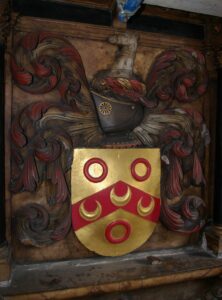
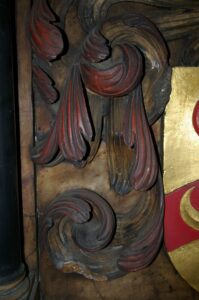

A talbot is a well mannered white hunting dog in heraldry. On the tomb the talbot is found on top of the heraldic helmet that is within the mantling. With all work completed the Seely and Paget restored shield now looks in keeping with its surroundings.


The Canopy
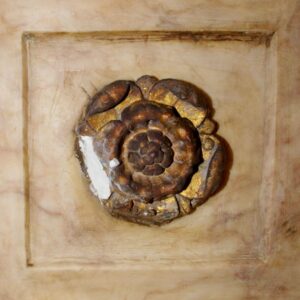
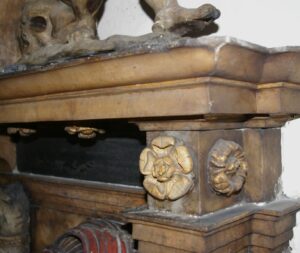
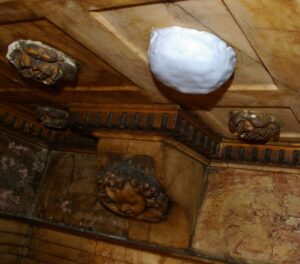
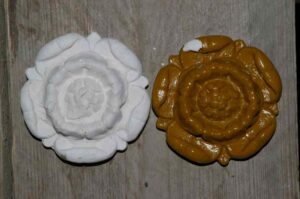
The main canopy and upper smaller canopy had rosettes of differing styles and condition. Where necessary replications were made and remodelled missing parts to match the originals.


Inscription Panel
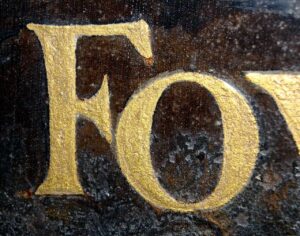
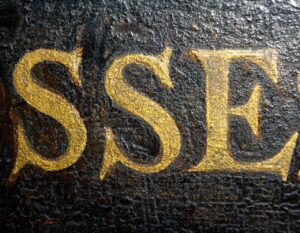
Below the canopy on the back wall is an inscription panel. It was clear that the current signwriting had been directly applied over previous signwriting. Paint sampling would determine the history of the lettering, however this was deemed too invasive. The panel was carefully cleaned.
The Base
The lower section of the tomb is directly behind the railings. All surface areas required thorough cleaning and, in part, filling and retouching. Both marbleised front panels required cleaning and reinstating where there were areas of loss.


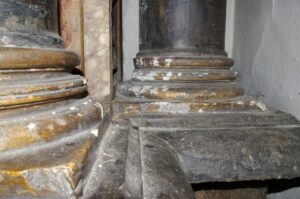
The marble was extremely dirty rendering it difficult to see any colour or detail (see below). After a deep clean the veining, detail and colours were revealed.



The Base – Marbleised Panels
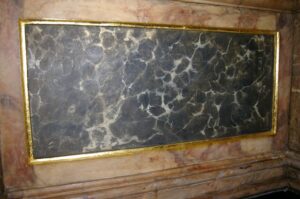
Both front marblised panels were first cleaned to reveal detail and colour. A paint sample was taken to microscopically analyse to understand the paint layer procedure, paint type and colours used. This information facilitated a faithful resintatement.
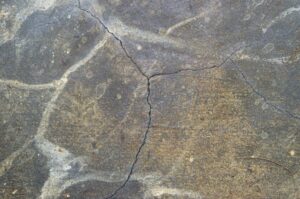

After cleaning the process of preparing, filling for reinstating the missing marbling was carried out carefully so as not to compromise the surrounding original.
The marbling was carried out with powder pigments and matched to the original (see below). This process dries lighter, however once the consolidant is applied the colours blend together.

Angels, Cherubs and Putti
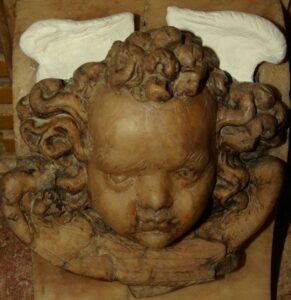
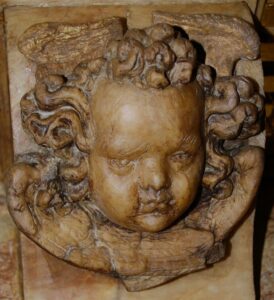
All angels, cherubs and putti were carved alabaster and all undecorated except the two uppermost winged cherubs which are painted and hold a gilded horn. Various treatments from cleaning to recreating and replacing missing carvings were carried out. Below shows one of three Angels of Death under the main canopy had missing wings. They were were replicated and and painted to match the original.


Two winged angels were missing their gilded horns. These angels sit beside Charity at the top of the tomb, they are painted and have gilt wings and horns. Where missing, the horns were remodelled, cast and gilded to match.

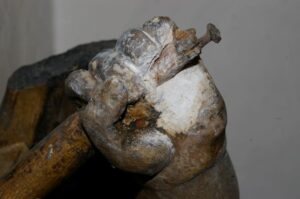


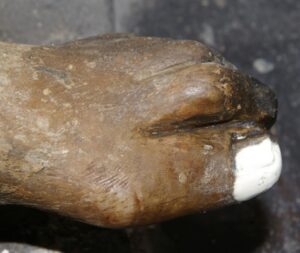
Wing tips and toe nail were also replaced.

Large Carved Alabaster Figures
Faith, Hope, Charity, Peace and Plenty are undecorated carved alabaster. Minimal previous fills and retouching were present, however these were deemed sound and needed no treatment. All were cleaned to remove surface dirt.


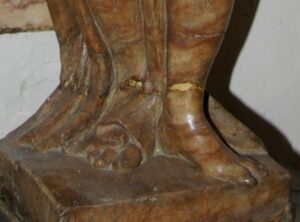
Both soldiers flanking the inscription panel are polychromed carved alabaster.

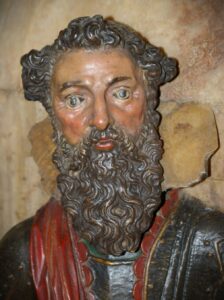

The Preacher Panel
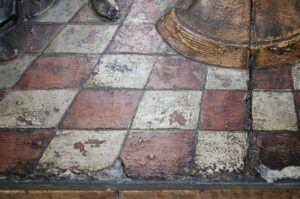
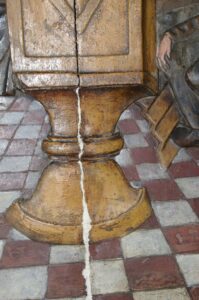
The polychromed alabster bas-relief had been previously retouched. A vertical running crack can be seen on the face of the preacher and the preaching pulpit. The whole panel was cleaned, small amounts of remodelling and retouching was carried out.
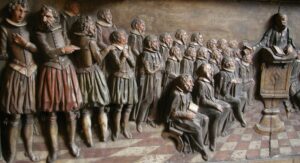



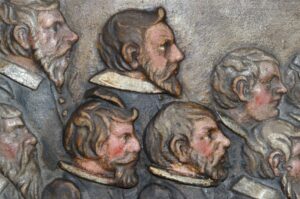
After cleaning, filling and retouching the panel was protected with a microcrystalline wax.

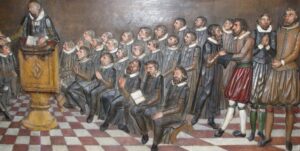
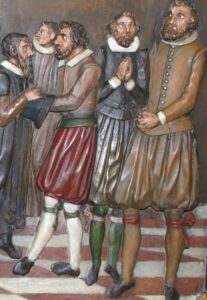
Before and after.

The Effigy of Thomas Sutton
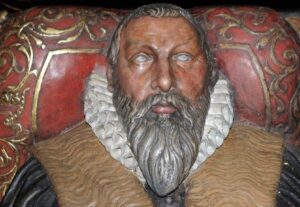
Thomas Sutton’s effigy had been previously over-painted. The objective was not to remove any historic over-paint but to clean, consolidate and retouch where necessary to deliver a unified whole. Cleaning tests prior to carrying out work are crucial to ensure correct solutions are used to carefully remove surface dirt whilst causing no harm to the painted surfaces and also that of the substrate.


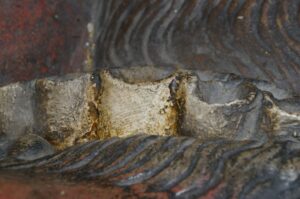
The head has a large chip to the left brow bone and the the digits on the hands clasped in prayer had suffered loss and previous filling. These items were remodelled and retouched to match.


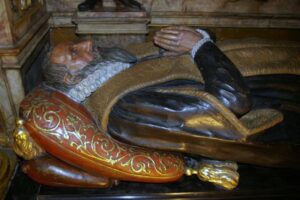
It is not uncommon to find areas behind an effigy unworked or unfinished as these areas are generally not seen however, Thomas Sutton’s effigy and surroundings were found complete.
Paint Sampling
It was known that the tomb had been overpainted. The objective was to clean, stabilise and retouch where necessary so therefore paint sampling was kept to an absolute minimum. However, samples were taken from the iron railings to understand the paint layer procedure and provide information to reinstate the original colour scheme.
Below are overall before and after shots.


Eskdale Restoration 2024. All content subject to copyright.
