The Conservation and Restoration of a Marble and Alabaster Memorial of Johannis Hullah
 This small case study is about the conservation and restoration of a small memorial to Johannis Hullah and is sited in the chapel cloister, Charterhouse, London. It can be found above the Wesley Room door (this door now functions as the exit door of the new museum room). John Hullah was an organist at Charterhouse and a mid-Victorian educator of music in London and he gave classes to the Working Men’s College and helped to establish Queen’s College in Harley Street, which was the first institution in the country to provide higher education for women. As Hullah got old his pupil, Mary Taylor, assited him. After his death in 1884 she was appointed Organist of the Charterhouse, a highly unusual position for a lady to hold at that time. Porter, S. “The London Charterhouse”, Amberley Publishing 2009.
The memorial is constructed of four marbles, a cream and a red alabaster. It also has Blue John studs around the circumference of the framework, although many of these were found missing. All surfaces were found in a dirty condition and a red and black wash was applied to all areas except the red alabaster brickwork background and the central circular panel. This addition was obscuring the true nature of the marbles. Although structurally sound the circular framework had numerous large cracks and fissures. It is known that after WWII Seely & Paget (John Seeley and Paul Paget) carried out extensive restoration works to the fabric of the building at Charterhouse in the 1950’s.
After cleaning was carried out on all surfaces it became clear why the application of the red and black paint was employed. It served to ‘blind’ and to try and unify a newly placed section of marble with the old. Presumably the original had been lost and damaged during the war. The new section was carved from a much darker black/red marble and can be identified as the horizontal band on the left side of the circular body. It had been expertly carved although it was the wrong colour.

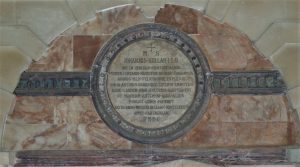
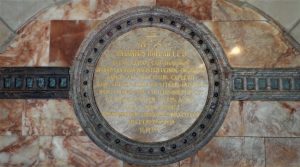
Photographs show condition before works.
Black paint was also found to cover the gold leaf incised lettering on the central panel. Paint samples taken confirmed that the gold leaf layer was the the original. It is unknown why the decision was taken to add an unattractive black to the lettering, we concluded that it was probably due to the toning down of the whole piece.


Photographs above show the red and black wash found on the framework, the missing Blue John studs and the removal of the black paint layer on the incised lettering revealing the original gold leaf layer.
The lettering was cleaned and re-gilded to bring back the original intention. The alabaster background and the lower red marble architrave were also cleaned to reveal the original colours of the materials. After cleaning ther whole memorial it was apparent which materials had been used to reassemble the memorial after the damage of the war and that it was liekly to have been originally sited in a different location in the grounds of Charterhouse prior to WWII. In its current location the added materials during the 1950’s restoration are believed to be the red alabaster brickwork background, the left side horizontal black/ marble band and the lower red marble architrave that sits just above the Wesley Room door. These additions may have been architectural damage from elsewhere in the building or brought in to aid in the reassembly of the memorial. The effort to restore this memorial by using materials available at the time can now be clearly seen.

Photograph shows the memorial after cleaning and before the replacement of the missing Blue John studs. Note the now apparent black marble band on the left.
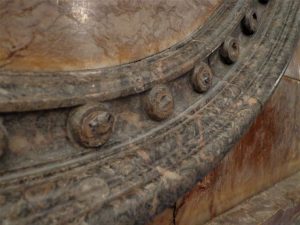
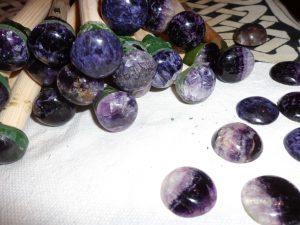
After all the cleaning and re-gilding had been carried out the last part of the project was to source, make and replace all missing Blue John studs. Blue john is a semi-precious mineral and can range from a yellow to a deep purple colour. It is an ornamental variety of Flour-Spar (calcium flouride). It is 4 on Moh’s scale of hardness and can easily be scratched with a sharp or pointed object. It is not that unlikely to find Blue John studs of varying sizes on a Victorian monument etc. although they often go missing. In this case 27 of 36 studs were missing (see photograph above). We found a supplier who could fashion the Blue John to the correct dimensions and once they were all made they were adhered into place.
The photographs below shows an area of missing Blue John, the newly crafted Blue John studs and the replacing of the stones.

This memorial is on the route of public access through the museum of The Charterhouse. This and many other objects and architecture in and around the museum, cloister and chapel are steeped in history dating back to the 14th century.