 Replicating Kent
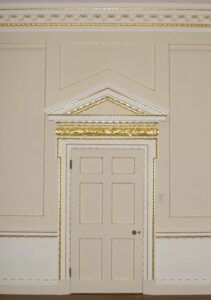
Our first project required the replication of various mouldings in the music room at Raynham Hall in Norfolk. Water ingress had resulted in damage to William Kent’s (1685-1748) interior in the music room. Messenger BCR carried out repair works, the redecoration to the walls, woodwork and conservation cleaning to the original gilding on the cornice and door pediment.
During the necessary redecoration process all other gilding was overpainted and required replicating to match Kent’s original gilding that still remained on the cornice and door pediments. The mouldings and areas that required matching included all shutter mouldings, the window architrave mouldings, all door architraves, associated mouldings and the dado rail.
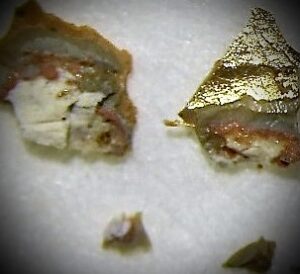
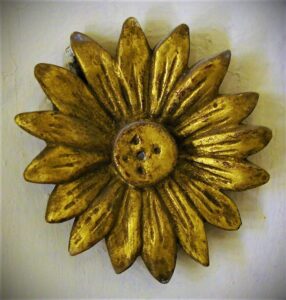
Before work was carried a paint sample (see left) was taken from Kent’s original scheme on the cornice. Often with conservation and restoration work we carry out architectural paint research (APR) to ascertain the decorative history, paint type, colour, finishes present and paint layer procedures of any given surface. This information is valuable for a number of reasons, in this case it provided material and colour information to facilitate a faithful replication of Kent’s gilt finish. The paint research also confirmed that the existing finish was Kent’s original work and that it has never been re-gilded and/or overpainted since the early 1720’s.
For other projects where we have employed APR in our work click here.
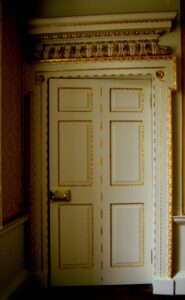
Below left shows Kent’s original cornice detail. This finish was to be replicated. Interesting to note here that the attention to detail in the upper areas of the cornice plasterwork was a little rough.


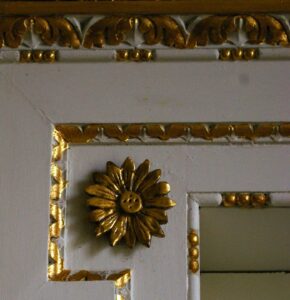
Detail of some original and replicated gilding.


Reinstating Kent
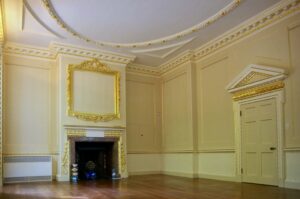
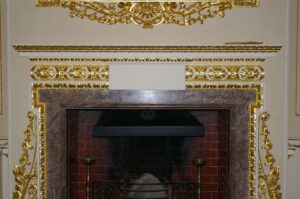
The second project is attributed to William Kent. A dining room in a mid Victorian house in Hertfordshire has panelling, associated mouldings and a carved wood fire surround that is believed to have been taken from a property in London and re-sited here when the house was built. Prior to work taking place the dining room had last been decorated in the 1980’s having an all white finish to walls, ceiling and woodwork with ‘gold’ paint applied to various moulding detail.
Gold paint is basically made of various metal powders suspended in a medium. The paint provides a quick, cheap solution to create a gold finish. Sometimes ‘gold’ paint may look reasonbly bright when first applied however over time the paint oxidises and turns a dull shiny brown, this can be clearly seen in the photographs below.


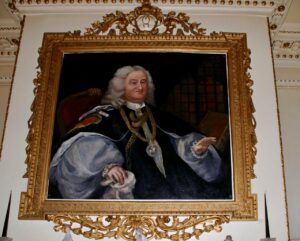

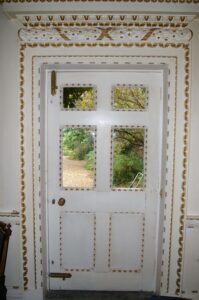

Paint samples were taken from the panelling and from the moulding elements to ascertain if any of the original paint scheme was present. Microscopic examination revealed that all the main panelling and the doors had a ‘putty’ colour present. A light stone colour was found on the dado wall, all architraves, the cornice and the fire surround. All expected decorative mouldings such as the egg and dart, bolection, bead and reel etc. were gilded. The sash windows were given a faux mahoganhy finish.


After preparation and painting, oil gilding was carried out using the tip and cushion method with real gold leaf. The elliptical ceiling relief has an abundance of fruit with intermittent crossed ribbons. The fruit relief was given an addtional glaze to help define the shapes and the ribbons gilded only. The photographs below show work completed.