
 The Castle Hill Club
What is now known as The Castle Hill Club in Lincoln’s historic Castle Square was formerly known as The Black Boy Inn. The Black Boy Inn is recorded as far back as 1745 and records show the building was a hostelry during the 1600’s, although it is not known if the same or a different name was used at that time.
The Inn has had some notable guests, one being the regular visitor and the British Executioner, William Marwood (1818-1883). He conveniently stayed at the inn when carrying out his executions in the adjacent grounds of Lincoln Castle. He was very interested in the ‘art’ of hanging and invented the ‘long drop’ which killed people instantaneously negating the need for friends and/or relatives to hang and pull on the legs of the guilty to mercifully bring about a quicker end for them. These people were known as ‘hangers-on’. A famous rhythm about Marwood at the time, ‘If Pa killed Ma who’d kill Pa’.
Another notable guest was engineer Isambard Kingdom Brunel (1806-1859). His business in Lincoln was to carry out a survey of Torksey Lock and it is said that he preferred to stay at the inn for the ale and entertainment.
In 1923 The Black Boy Inn was closed. The bemused regulars came together and founded the Castle Hill Club, which remains to this day.
The Sign
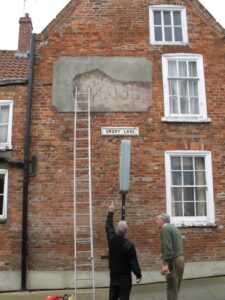
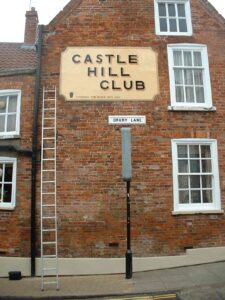
The sign has a cementitious substrate and it is clear that it had been previously repaired, these ‘new’ repairs have no evidence of a decorative past. Although there were paint fragments and faint lettering could be detected on the original. it was clear the lower word spelt CLUB, above this two verticles present formed part of the letter I and L. No further lettering wa sfound. It was safely assumed that the last decorative intervention read CASTLE HILL CLUB. It is unknown when and why the sign’s decoration discontinued.
The last complete scheme on the sign had read, “Hewitt Bros. Ltd. Grimsby, Gold Medal, Ale & Stout, Wines & Spirits” as seen above in the undated black and white photograph. in this photograph advertising the exterior wall suggests a possible date of around 1920. This date comes around the time of a change of hands in ownership. It could be possible that the photograph was taken by the Black Boy Inn before their departure or it may have been taken after 1923 by the new owners who were to become the Castle Hill Club.


The Restoration
Paint samples were taken for analysis to determine colours and schemes. The information found during the paint sampling together with evidence of the last painted design allowed us to produce the five schemes for the forthcoming reinstatement of the sign (see below).
It was decidied that the light cream background and black block lettering with an ochre shadow scheme was to be reinstated.


Behind the scenes work of setting out, drawing and hand-mixing paints to match the original are carried out first before any practical work of reinstating the signwriting is begun.
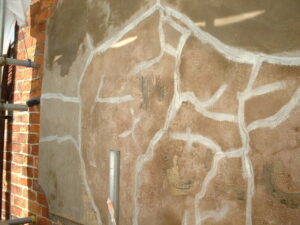

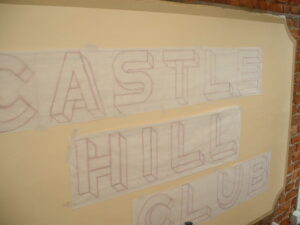
All practical work was carried out in the traditional manner. This approach produces an authentic result opposed to a computer generated result.


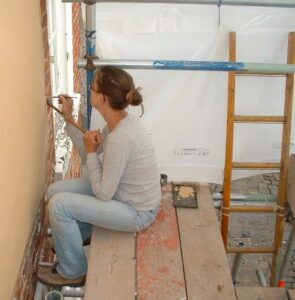
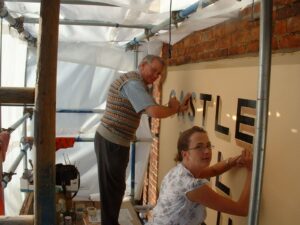
Once the drawing had been transferred onto the surface all the block lettering were completed in black. This was followed by an ochre shadow.


Upon the ochre shadow red lines are added to cast additonal shading on the shadow.

 Maintenance
This sign was first restored 18 years ago back in 2006, thereafter it has been restored as and when necessary. Since then, due to incompatible building materials, the sign has to be restored apporoximately every 3-4 years. Below shows a later restoration in progress.


Footnote
For us, it is an attestation to the importance of apprenticeship. The skills transferred by master craftsmen should not be underestimated, their apprentice will, in turn, pass it on so skills are kept alive.


 With the deepest gratitude and in loving memory of Master Craftsman Nigel Leaney of Lincoln (1942-2022)
