

Nave looking east. Nottingham Cathedral 2022.
St. Barnabas’ Cathedral (now known as Nottingham Cathedral), presbytery, convent and furniture was designed by AWN Pugin, the works were completed by George Myers in 1844 and was mostly funded by Lord Shrewsbury. Today, for the exception of the Blessed Sacrement Chapel, the nave roundels and the three eastern chapel reredoses, nearly all walls and ceilings have been overpainted in white, the ceilings beams; a faux wood finish. Alterations to the interior fabric were carried out in the 1930’s, the 1960’s and the 1990’s.
Our initial brief was to establish if Pugin’s decorative scheme remained underneath the current overpaint, or, if indeed, it existed at all. There was very little information regarding the original decoration, just rumours and the odd reference that had been passed down the generations.
Our initial paint sampling established five decorative schemes on the interior walls, ceilings and associated architecture. The very first of the schemes was indentified as Pugin’s decoration. Paint samples were taken for analysis from strategic locations and analysed to identify paint layers procedures, colours and paint type. The samples also provided the opportunity to exactly recreate the colours of any of the schemes. However, in this case, the focus is was on Pugin’s colour scheme (see photo below).
Efforts to determine what has occured, and in what order, can, sometimes, be quite challenging. The ceiling bed cross section (see photo below left) had more than five schemes present. It had two more paint layers than expected. The reasons for this needed answering so we could be assured in knowing that what we were observing was understood and correct. Extensive archival research provided the answer and the additional layers in the sample could be accounted for, and in this case, adds an important part to the Pugin story, thus facilitating a greater understanding of our history. Paint research is greatly informed by archival material as it can help to pinpoint, clarify and add information that could otherwise be lost and/or misunderstood.
Below is a selection of cross sections (x 40 – x100 magnification) showing blue, green white, stone, and umber colours taken from various locations within the cathedral.


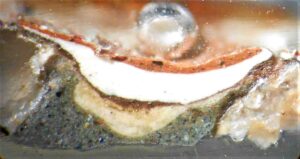

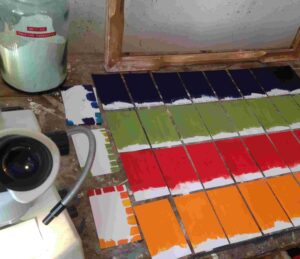
Above left shows a ceiling bed cross section. Note the raised yellow area. This formed part of Bishop Bagshaw’s stencilled star design. Right photo shows some of the hand-mixed exact colour matched swatches of Pugins palette.
Once the paint sampling and analysis had been concluded further on site investigations were advised to better understand the colours found, to locate and identify designs and any counter-changing schemes, historic decorative finishes such as marbling, woodgraining, scumbling and gilding etc. We refer to the exposing sections of underlying decoration as ‘window exposures’ or ‘windows’. A ‘window’ was exposed on an area of a pointed arch and after the removal of four top coats Pugin’s stencil design revealed itself.
Below, from left to right: Preparing a ‘window exposure’ by masking out the selected area on a pointed arch. The middle photograph shows the ‘window’ after the removal of four overpaints. The far right photograph shows a different angle of the found designs and stencil work on the pointed arch.


These findings were extremely encouraging. Other locations in the nave, the west wall, the north and south aisles, ceiling beds and beams were prepared for similar window exposures, which proved equally as revealing. Below left photograph shows a ceiling bed with three star designs evident. The Pugin scheme (1844) is a simple repeat pattern six pointed star stencil design. This is followed later with a more elaborate stencilled star design applied by Bishop Bagshaw in the late 19th century, again a repeat pattern design. The last star scheme discovered on the ceiling bed was of a smaller, lighter yellow stencilled star design by Bishop Dunn in 1927, this can be seen in the below right photograph on the right hand side ceiling bed.


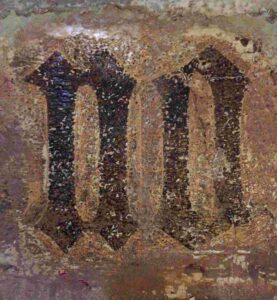
Below the sloped ceiling beds inscriptions were discovered (see above middle photograph) on the wall which runs all around the nave. Closer inspection and paint sampling revealed the signwriting had been carried out twice, both times conveying the same Latin script; a morning prayer, a canticle:
Benedicite, omnia opera Domini, Domino; laudate et superexalttate eum in saecula.
Benedicite, caeli, Domino, benedicite, angeli Domini, Domino.
Benedicite, aquae omnes, quae super caelos sunt, Domino, benedicat omnis virtutis Domino.
Benedicite, sol et luna, Domino, benedicite, stellae caeli, Domino…..
And so on….

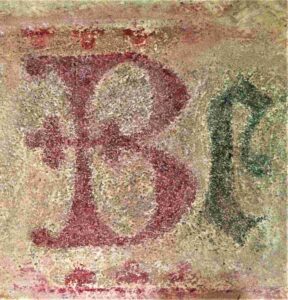
The lettering has been identified as Pugin’s alphabet No. 3. As is typical all capitals are carried out in a red. Decorative terminals and borders are also employed and carried out in red.
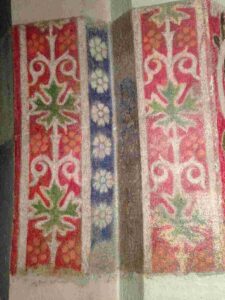
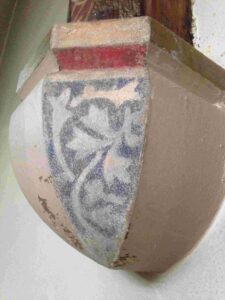
Below left is a typical stylised stencil design, this example is found on the pointed arch in the nave. The centre photograph shows more script, identified as alphabet No.1, that has been revealed on the nave walls. The extent of the lettering and the message it conveys has yet to be discovered and further research will determine if the gilt trefoil border and strong red line is Pugin’s work or that of a later addition. The photograph on the far right are the designs and colours discovered and revealed on the stone corbels in the nave.


This work is ongoing.

