Bell ringing started in England at the end of the 16th century. They could be rung with a full wheel allowing the bell ringers to produce continuously changing patterns of sound. Tunes cannot be played due to the nature of the bell and how it is rung, but a great variety of sound and rhythms can be achieved.
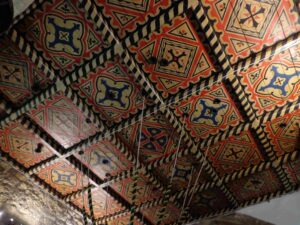
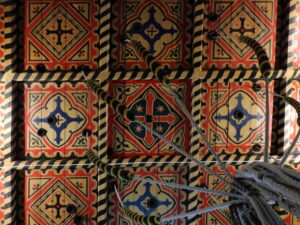
The decoration of bell tower ceilings vary. St. Andrew’s at Kirton In Lindsey has a polychromed stencilled design covering twenty panels. The central panel is unique and this is surrounded by a formation of three repeat pattern cross designs. Our brief was to conserve all painted wooden elements of the ceiling and restore where necessary.
The condition of the ceiling was poor. There was evidence of some of the board lengths being uplited and re-sited creating slight misplacements and gaps. Additions of painted lengths of random timber were added to presumably disguise damage and/or support the main painted lengths. No access above the ceiling was available to confirm this. These added lengths were found to be stable so they remained in situ and, once the ceiling was cleaned and consolidated, they were repainted to match the original colour and design surrounding them.
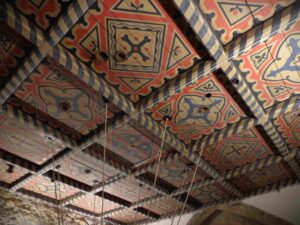
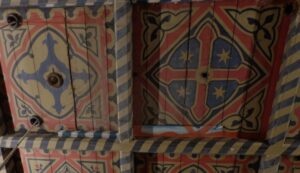

There were eight functioning ropes coming down through collared cavities, all in good condition and having a black finish. The collars allow the ropes to slide effectively and smoothly through the ceiling. There were a variety of further disused collars, some of a trumpet shape, that remained on the ceiling, these were suffering from metal corrosion. There were also a number of circular cavities that had no collars which had either been intentionally removed or had fallen.

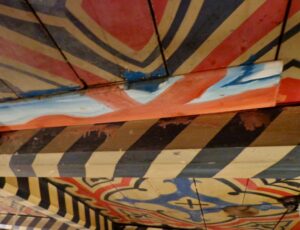
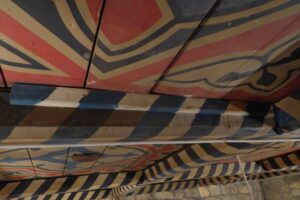
Once all surface areas were cleaned and consolidated. The paint for the areas to be restored was hand mixed to an exact match and applied where necessary. All metal corrosion on collars were treated and where there were missing collars, they were replaced with replicas made and then painted to match.
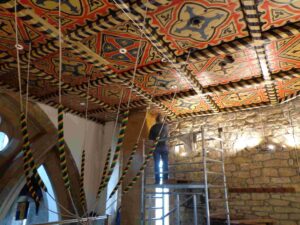

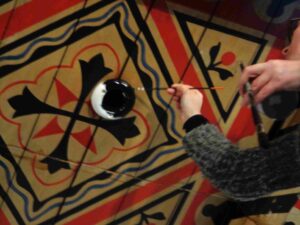


The after shots…