

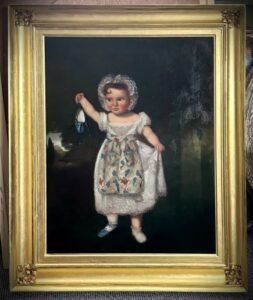
The conservation and restoration of the painting of Charlotte Alington Barnard nee Pye and the restoration of the frame.
We spent few weeks with a portrait of Charlotte Alington Barnard and her frame. Charlottle’s life was cut short and her story is a sad one, however, she was commercially very successful. Directly below is an extract taken with kind permission from Louth Museum’s website about Charlottle and her life. This is followed by a short piece about the conservation and restortion of this painting and frame.
Claribel
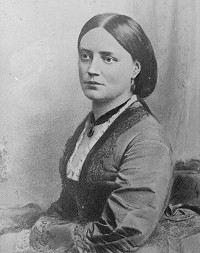 Claribel (Charlotte Alington Barnard, née Pye) 1830 – 1869 has been described as ‘one of the most commercially successful ballad composers of the 1860s. Her songs were to be heard in British and American homes for the rest of the century, despite her early death.’ She was born and brought up in Louth, in a middle class Victorian home. Although she lived in London for a few years when she was first married, she spent most of her life in northern Lincolnshire, and much of her social life was in Louth. Claribel had started writing poetry as a little girl – one of her earliest recorded poems ran to 20 verses! Although she wrote both words and music to some ballads, she often wrote her music for the words of some of the most famous poets of the day. Among these were Tennyson, Charlotte Bronte, Longfellow and Charles Kingsley. In the ten years between the publication of her first piece and her death (at the age of 38) almost 100 compositions appeared on publishers’ lists.
Claribel’s music
Today the only song of Claribel’s which is widely known is ‘Come back to Erin’. However, it is usually called an Irish folk song, and is found in many folk song collections. In the early years of the 20th century two of the foremost singers of the day made recordings of this ballad, more than 40 years after Claribel’s death. The recordings of Nellie Melba (later Dame) and John McCormack are still available – fortunately transferred from wax cylinder to more modern media
 In the 1860s and the later part of the 19th century her ballads were performed by the most famous singers of the day. Before downloads, CDs, vinyl or even wax cylinders were thought of, live concerts were the only way of hearing new songs. Boosey and Sons (now Boosey and Hawkes), a major music publisher, put Claribel under contract, which was quite unusual at the time. By the late 1860s they had about 45 of her works in their catalogue. Some were set as duets, some had been arranged as piano solos, and some were in albums of songs. This compared with 9 songs by Arthur Sullivan (later knighted, of ‘Gilbert and Sullivan’ fame) named in ‘Boosey & Co’s list of Popular Songs’.
Then, as now, there was friction between ‘serious’ and ‘popular’ music. Music critics described Claribel’s ballads as ‘mawkish’ and ‘trashy’. Audiences, on the other hand, demanded encores whenever they were performed. Not for nothing were they known as ‘parlour songs’. With the availability of sheet music and pianos in Victorian homes, Claribel’s songs found a wide and appreciative audience. They were not too difficult to sing, and the piano accompaniment was relatively easy. Some songs were so well-known they could be parodied, and even contemporary cartoons referred to them. Her first published ballad, from ‘The Brook’ by Tennyson, was the subject of a cartoon in 1866.
The caption is: “Elderly Girl at Piano (singing ‘The Brook’): Men may come and men may go, But I go on for ever – ever – I go on for ever. Charley (to fair cousin): If that’s the case, I shall be one of the men that go.”
Family
Claribel was the third child of Henry Pye and Charlotte (nee Yerburgh). They lived at The Cedars in St Mary’s Lane, Louth. The house, which still exists, is well shown in Brown’s Panorama of Louth. Two figures in the garden could be a teenage Claribel and her mother. Her two older brothers had both died, one at a few hours old, and the other just 12 days old. Her mother died when Claribel was only 17.
Henry was a solicitor and businessman in Louth. He also held several public offices, so was very well-known in the area. Her mother, Charlotte, was originally from Frampton, near Boston. The family name Pye was taken by Claribel’s father, Henry Alington, under the terms of the will from which he inherited the fortune of his aunt Sarah Rowe. Henry remarried just two days after Claribel’s wedding. His second wife was Lady Albina Francis Hobart, a woman with her own fortune.
Married Life
Claribel married Charles Cary Barnard in 1854. She had been engaged twice previously. Although not an ‘arranged marriage’ in the sense we might understand today, Claribel’s marriage to Charles Barnard was certainly arranged by her family. One engagement had been to John George Holloway, a London barrister, whose family lived at Gunby Hall about 20 miles south of Louth. Claribel’s father felt this was not a suitable match! Charles was rector of Ruckland, and Farforth with Maidenwell, although Claribel and Charles lived at The Firs in Westgate, Louth when they were first married. In 1857 they moved to Pimlico, then a fashionable area of London. It was here that Claribel met other musicians, had lessons in piano and composition and wrote her first published pieces. By 1864 when she and her husband moved to Kirmington Rectory, Claribel had become one of the most popular composers of the day. She continued composing until 1868.
Claribel died in Dover in January 1869, of typhoid fever. She is buried there. Claribel’s father had many business interests in Louth and the surrounding area, as well as being a land speculator and County Treasurer. However, in the summer of 1868 he was exposed as an embezzler and declared bankrupt, having siphoned off county funds and owing large sums on mortgages and small sums to his servants. Henry Pye, accompanied by his second wife and their young daughter, fled to Belgium. Claribel and Charles joined them there, Claribel herself having lost about £30,000. She and her husband returned to England at the beginning of 1869 for a holiday, but she became ill and died after a short illness. Charles Barnard remarried, and lived to a ripe old age, having fathered six children. Henry Pye remained in Belgium, his lifestyle supported by his wife’s fortune.
For more information and to arrange a visit click Louth Museum.
 In March 2024 the painting and frame came up for auction at John Taylors Auction Rooms in Louth and was acquired by Louth Museum. A link to a BBC article can be found here.
We were very pleased to be able to offer our services to the Museum to conserve Charlotte’s portrait and restore the frame.
Painting Condition Assessment and Proposal
A relined oil on canvas. It was more than likely that at the same time as relining repairs to the canvas, re-filling, retouching and overpainting had also been executed; albeit in this case, poorly.
The original canvas has a previously repaired tear on the child’s face which had been retouched/overpainted.
The paint film had a large amount of cracking on the upper section. There are also areas of delamination, loss and ‘cupping’. ‘Cutting in’ around the child is clearly evident. Much of the chosen retouch and repaint colours were ill-chosen.


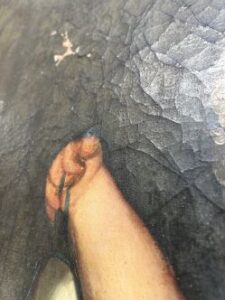
Conservation of Claribel
To prevent further paint loss during the forthcoming cleaning process it was necessary to consolidate all loose paint films. This was achieved by using a conservation grade, heat activated medium which allows the cupped paint to be repositioned and the loose flaking paint to be safely adhered back into position. This is a labourious yet very satisfying process.

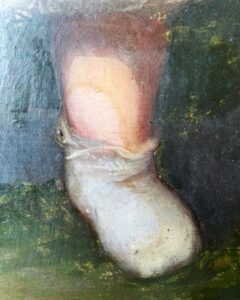
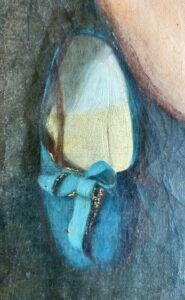
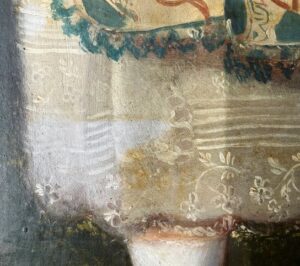

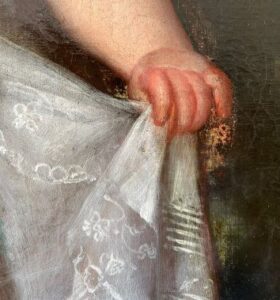
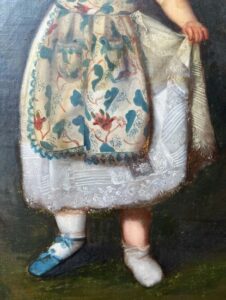
All surface areas were cleaned followed by the removal of a thin varnish layer which allowed the underlying colours to reveal themselves. AT this stage all old filling materials was removed. An interstitial layer is then applied after the cleaning and varnish removal process. This layer is a isobutyl methacrylate polymer, a conservation grade consolidant/varnish. This layer further consolidates the the surface and also provided a barrier between the original surafce and any firthcoming applications i.e. filling, retouching, repainting. It also helps to achieve the correct colour match when retouching and reapinting as it saturates the surafce bringing out the true colour of the painting.

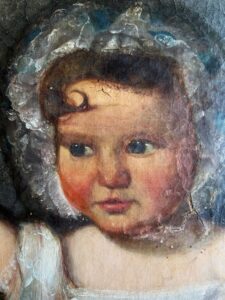
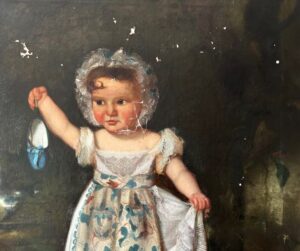
The painting was finally ready for retouching. We know some of the painting, such as the apron is an historic overpaint. We also know that there was no original paint exisitng underneath this layer. In this situation the aim was to unify the painting by keeping some later interventions alongside the original.
The Frame Restoration
The frame is of good quality and compliments the painting however it was found in an extremely poor condition. There was gesso loss with the top edge of the frame suffering the most. Some mouldings had extremely poor applications of a previous fill in an attempt to remedy the original gesso loss however this was most unsatisfactory and had failed to provide a stable surface or give a pleasing aesthetic. This previous fill had also suffered loss exposing the original timber.
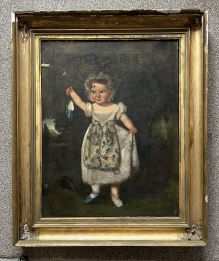
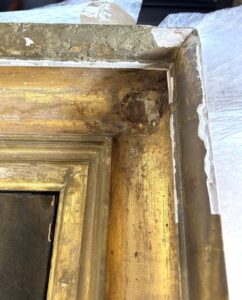
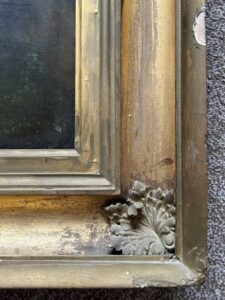
The top edge moulding and the site edge mouldings had a bronze paint applied in an attempt to unify the previous restoration work. Over time bronze paint oxidises and turns brown. The slip (an inserted flat or bevelled strip fitted into the rebate) had insect infestation and had extensive damage on the botoom rail. Only one of four corner ornaments remained. The deep back edge of the frame had two historical rabbet colours applied.

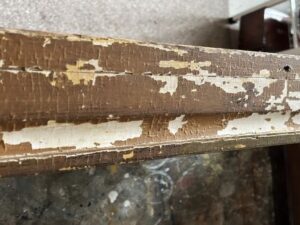
Before restoring the frame back to its original appearance investigations and analysis was carried out to ascertain the decorative history and identify materials present. This information allows for a greater understanding of the life of an object and also faciliates a faithful restoration. This frame was originally water gilt (matt and burnished) onto a black bole, the large hollow had a grey bole. The four corner mouldings were oil gilded. Some time after this the frame was again water gilt as before only this time using a red bole, see the above photograph showing both the black and red bole layers. For more information about gilding click here.
The frame was to receive a full restoration back to its original appearance using the same materials and techniques as per the original. It was to be then toned down to compliment the painting.
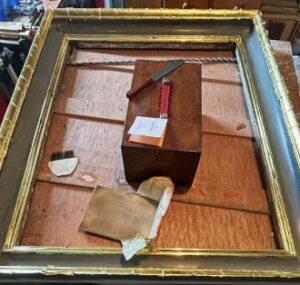
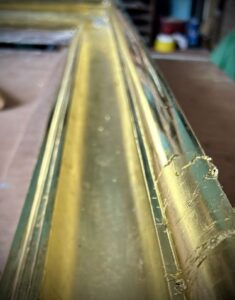
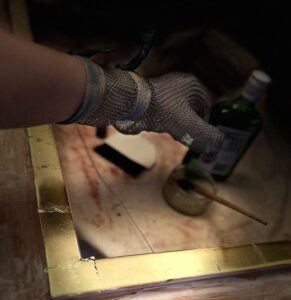
The likely materials to be found, in order, on a water gilt frame are:
- Wooden substrate
- Glue size
- Gesso (calcium carbonate)
- Coloured bole layer (typically red and/or yellow)
- Gold leaf (no leass than two layers)
Possible materials to be found on an oil gilded frame:
- Wooden substrate
- Thin oil based priming layer with or without added pigment
- If no pigment is added to the above a ground colour can be added to the undercoat
- An oil based (polymerised linseed oil) size with an added siccative
- Gold leaf
- Possible applications of traditional glue size toning/wash of powder pigments suspended in a glue size
Both these methods are often employed on the same frame. The treatment of the of this frame consisted of a mixture of matt and burnished water gilding. This effect creates movement and any forthcoming toning accentuates light and shade.
All content subject to copyright.

