

A Recollection of AWN Pugin's Mother

Lincoln Cathedral Nave. Looking West.
When staying with a friend at Lincoln whose house adjoined the cathedral, she (Catherine Pugin) frequently visited a prebendary who lived in the Close. The nearest way between their houses was easily effected, when the cathedral was open, by passing through the church and cloisters. The verger also, by way of accommodation, when he knew that it was required, left the cathedral doors unlocked, so that the prebendary and his friends might use this short road of an evening, instead of making a long detour outside the precincts. It happened one summer evening that Mrs. Pugin had been dining at the house of her clerical friend, and on parting at night declined an escort, and took her usual path through the Lincoln Cathedral . Entering the door, she closed it and passed to the opposite portal, which to her surprise was locked. The door by which she entered being fitted with a spring lock, she suddenly found herself a prisoner in the cathedral. She made every effort to arouse attention by shouting through the keyhole and shaking the door, but without effect, for at that late hour everybody had gone to rest. It was a fine moonlight night; thus she was not left in darkness, and concluding that her absence from home would soon cause a search to be made and save her from a cold night’s lodging in the cathedral, she easily composed herself, and seated upon a bench, was contemplating the beautiful effects of the light and shade upon the pillars in the nave, when suddenly there appeared through the silvery light the figure of a man looking down upon her from one of the openings of the triforium, which as suddenly disappeared. For the moment she was willing to believe that the apparition was only a

Lincoln Cathedral Choir and triforium. Photograph taken from the top of the pulpitum, 2018.
phantom created by her imagination , and having a large amount of courage and self-possession, thought nothing more of it. A few minutes aftrewards, however, she again saw the appearance of a man looking over the gallery front, nodding his head and beckoning to her with his hand, who then vanishes again. Her alarm was now really excited, for it was difficult to suppose that this nocturnal visitor could be in the cathedral for any good purpose. Impelled by fear, she moved from her position and entered the choir, seating herself in one of the stalls. Every minute now seemed hours to her, and taking a prayer book, she sought by the aid of the moonlight to read; but fancying she heard the unlocking of the outer door, looked up, when to her horror she saw, staring in the opposite gallery front just above the book-board, a grizzly head, with the face directed towards her nodding and grinning most fearfully. Her courage now forsook her, but happily at this moment the cathedral door was really heard to open, and rushing away she was met by her friend and a servant. Uneasy at her not coming home, they had repaired to the Close, and the clergyman at once concluded that by some accident she might be locked up in the cathedral.
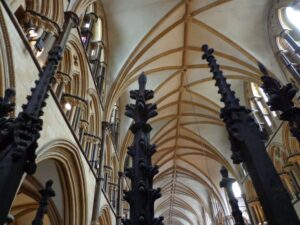
View from the top of the pulpitum looking up to the triforium.
The cause of her alarm was soon explained. A poor idiotic youth who had escaped from the care of his friends, was, like persons thus afflicted, fond of prowling about and prying into odd places. The cathedral was his favoutite haunt, and finding the door unlocked he entered and amused himself by running from place to place; it was his eractic movements and awful grimaces which had well nigh bereft Mrs. Pugin of her senses.
Lincolnshire was AWN Pugin’s home from home and he was often at the cathedral for hours on end drawing and sketching from all angles and heights. Hill (2007) tells of the cathedral guides who used to point him out to visitors when he could be seen in various parts of the building. It is, of course, no doubt that the love Pugin had for the architecture and decoration of the Early English Gothic is clearly reflected in his own work and the influence of Lincoln Cathedral, is believed to have played a large part. It can be supposed

Lincoln’s medieval carved stone pulpitum c.1330.
that in the first half of the 19th century when Pugin was frequenting the cathedral that he studied the medieval carved stone pulpitum (choir screen). Although the pulpitum appears to have lost much of its decoration, it does, in fact, retain a great deal of evidence of a very bright and colourful past, of which, it is believed Pugin was aware and recorded for his own use. For a short summary of our paint research of Lincoln Cathedral’s pulpitum click here.
